Psoas and Iliacus Tightness: Every Question Answered (The Complete FAQ)

At a Glance
The psoas and iliacus are two deep muscles that work together as your primary hip flexor. Sitting for long stretches keeps both shortened, which can contribute to lower-back tightness, hip stiffness, and a forward-tilted pelvis. Because they attach to different structures — psoas to your spine, iliacus to your pelvis — each responds best to its own release technique. This FAQ covers everything: what they are, what tends to go wrong, and how to work on them at home.

In This Article

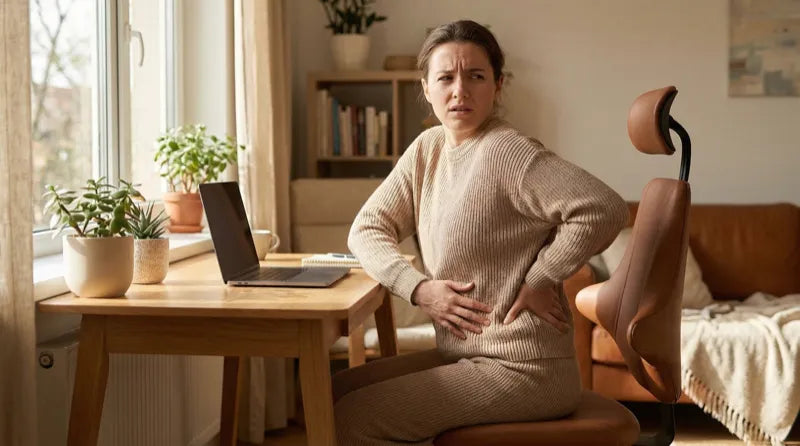
AI-generated (Nano Banana Pro) — person at desk pressing lower back/hip in discomfort → uploaded as article-pp01-hero.webp
Person sitting at a desk pressing their lower back and hip area in discomfort, illustrating recurring hip-flexor tightness Recurring hip-flexor tightness often shows up as lower-back stiffness that keeps coming back — no matter what you try.

Whether you just heard about the psoas and iliacus for the first time or you’ve been dealing with hip-flexor tightness for years, this page answers the questions people ask most often — clearly, practically, and without medical jargon.

One thing you’ll notice: the psoas and iliacus are always discussed together here. That’s intentional. Working on just one without the other is the most common reason easing doesn’t last.

80% of Adults will experience lower-back tightness or discomfort at some point in their lifetime.
Two deep muscles most people have never heard of are behind many of those cases.

The Basics: What Are the Psoas and Iliacus?

What are the psoas and iliacus muscles?

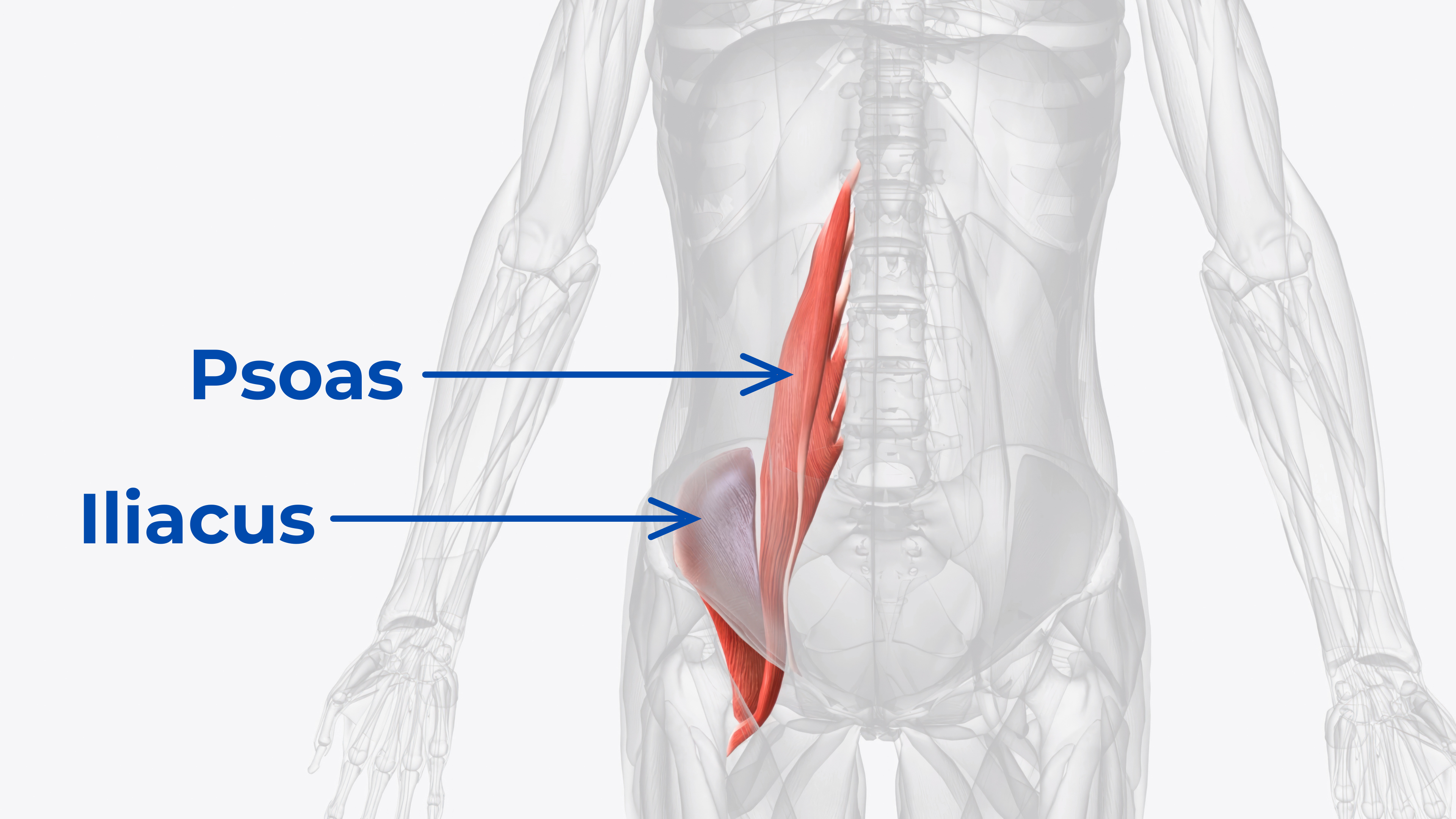
The psoas (pronounced “SO-az”) major is a deep core muscle that runs from the front of your lower spine (T12 through L5 vertebrae) down through your pelvis and attaches to the top of your thigh bone (femur). It’s the only muscle that directly connects your spine to your legs.

The iliacus lines the inside of your hip bone (the iliac fossa) and attaches to the exact same point on the femur. Together, they form the iliopsoas complex — the most powerful hip flexor in your body and a key stabilizer of your lumbar spine.

While they work as a team, they attach to different structures (psoas to spine, iliacus to pelvis) and can develop tightness independently — which is why both are worth addressing.

CDN shared asset — anatomy-psoas-iliacus.png
Anatomical diagram showing the psoas and iliacus muscles connecting the spine and pelvis to the femur The psoas runs from your lumbar spine; the iliacus lines the inside of your hip bone. Both attach to the femur.

Where is the psoas located?

Deep in your abdomen, right against the front of your lumbar spine. You can’t feel it from your back. You can access it from the front by pressing gently inward beside your navel — but most people don’t know it’s there, which is why it’s often called “the hidden muscle.”

What does the psoas do?

Four primary functions:

  1. Hip flexion — lifting your knee toward your chest
  2. Lumbar spine stabilization — keeping your lower back aligned
  3. Spinal rotation and side-bending
  4. Postural maintenance — keeping you upright

The psoas also shares fascial connections with your diaphragm, which means it can influence your breathing.

Why both muscles matter: The psoas and iliacus attach to different structures but pull on the same bone. Working on one while the other stays tight is why so much easing feels temporary.
===== SECTION: tension AND SYMPTOMS =====

Sensations and Patterns

What does psoas tightness feel like?

Psoas tension is typically a deep, dull ache or pulling sensation in the lower back, front of the hip, or groin. It’s often described as a “pulling” feeling rather than a sharp one. It tends to feel worse after sitting for a while and may ease with movement. Some people feel it as a general stiffness in the hip area rather than a specific point.

Can tight psoas and iliacus affect how your lower back feels?

Yes — this is one of the most common patterns. A tight psoas pulls your lumbar vertebrae forward, creating an exaggerated arch in your lower back. Meanwhile, a tight iliacus tilts your pelvis forward from the hip-bone side. Together, that double pull adds load to the lower back.

A lot of recurring, hard-to-pin-down lower-back tightness comes back to combined psoas and iliacus tension.

Can tight hip flexors create tension that radiates down the leg?

They can. The lumbar plexus runs through the psoas, so when the psoas stays tight it can create a pulling or radiating sensation through the buttock and leg. A tight iliacus can add to this by changing how the pelvis sits. Easing tension in both muscles often calms that radiating feeling.

Can tight hip flexors affect the knee?

Indirectly, yes. A tight psoas tilts the pelvis forward, which alters how the femur rotates, which changes how the knee tracks. Knee discomfort without a clear structural contribute to often traces back to hip mechanics, and the psoas is frequently part of that upstream picture.

Can the psoas contribute to hip clicking?

Yes. Internal hip snapping — a click or pop in the front of your hip, usually when standing up or extending your leg — is commonly caused by the iliopsoas tendon snapping over a bony prominence in the pelvis. Reducing psoas tension reduces tendon tension, which often reduces the click.

Can a tight psoas affect breathing?

Yes. The psoas and diaphragm share fascial connections at T12. Ongoing psoas tension can restrict how fully the diaphragm moves, leading to shallow, chest-dominant breathing. Many people report deeper breathing after psoas release.

Can the psoas affect the pelvic floor?

The psoas is fascially connected to the pelvic-floor area through the endopelvic fascia. Because of that connection, ongoing psoas tension can add to tightness in the pelvic-floor area for some people.

The pattern to watch for: Lower-back tightness + hip stiffness + one or more “mystery” sensations (knee-tracking changes, hip clicking, shallow breathing, pelvic-floor tightness). When several of these show up together with no clear structural contribute to, the psoas and iliacus are often part of the picture.
===== SECTION: contributes to =====

What contributes to Tightness

AI-generated (Nano Banana Pro) — Core Nexus tool on clean white surface, dual tips visible → uploaded as article-pp01-product.webp
Blue Core Nexus psoas and iliacus release tool on a wooden surface with yoga mat in background The Core Nexus uses muscle-specific tips — one contoured for the psoas, one for the iliacus inside the hip bone.

Why are my psoas and iliacus tight?

The most common contribute to is prolonged sitting. When you sit, your hips are flexed at 90 degrees, and both muscles are in their shortened position — the psoas along your spine and the iliacus inside your hip bone. Hours of sitting, day after day, contributes to both to adaptively shorten. They “learn” this contracted length as their new normal.

Other contributors:

  • Stress — the psoas is sometimes called “the fight-or-flight muscle” because it contracts during the stress response, and the iliacus follows
  • Intense exercise without release work — running, cycling, and heavy squats all load the hip flexors without lengthening them
  • Poor sleeping positions — the fetal position keeps both muscles shortened overnight

Does stress affect the psoas?

Yes. The psoas is part of the body’s fight-or-flight response. During stress, the nervous system activates the flexor chain — preparing you to curl up protectively or run. Ongoing psychological stress can keep low-level psoas contraction going even when there’s no physical threat. This is why some people feel more back and hip tightness during high-stress periods even without changing their activity level.

===== SECTION: approach =====

Release and Self-Care

How do I release my psoas and iliacus?

Both muscles benefit from separate, targeted release because they’re in different locations:

  • For the psoas: Lie on a firm surface, position a release tool beside your navel, and let your body weight apply pressure into the psoas through the abdomen. Hold until you feel the tissue soften.
  • For the iliacus: Reposition the tool to the inside of your hip bone, where the iliacus lines the pelvic wall. The iliacus benefits from a narrower, angled approach to reach it inside the hip bone.

Release both, then follow with a hip flexor stretch. The key is addressing both muscles in each session — working on one while the other stays tight is why so much easing feels temporary.

How do I release my iliacus specifically?

The iliacus benefits from a different approach than the psoas because it sits inside the hip bone, not along the spine. You want a tool with a narrow, angled tip that can follow the curve of the hip bone inward to reach the iliac fossa. Position the tool inside the hip bone, apply sustained pressure, and hold until the tissue responds. The Core Nexus has muscle-specific tips designed for each muscle — one for the psoas and one specifically contoured for the iliacus.

Will stretching be enough for a tight psoas?

Stretching helps but doesn’t fully address ongoing psoas tension. A kneeling hip-flexor stretch temporarily lengthens the muscle, but it can’t work on tight spots (localized knots of contracted tissue) within the muscle belly. For better results, combine direct pressure release with stretching — release first, then stretch.

How often should I release my psoas and iliacus?

Daily, if you sit for extended periods. Both muscles shorten every day you sit, so they benefit from daily attention. Most people build this into a morning or evening routine — releasing both the psoas and iliacus on each side. Consistency matters more than any single session.

How long does it take to see results?

Many people feel a difference right after their first release session — a lighter feeling in the hips, easier standing, less lower-back tension. With consistent daily practice, that easing tends to build over time.

The daily protocol: Release psoas (both sides) → release iliacus (both sides) → hip flexor stretch. Takes about five minutes. Morning or evening. Every day you sit is a day both muscles benefit from attention.

Tools: What Works and What Doesn’t

What’s the best psoas and iliacus release tool?

Look for a tool that:

  1. Targets both the psoas AND iliacus with muscle-specific tip shapes (not identical tips — each muscle needs its own geometry)
  2. Stays stable on the floor under body weight
  3. Allows leg rotation during release
  4. Is durable enough for daily use

Most tools on the market only address one muscle or the other — psoas tools can’t reach the iliacus inside the hip bone, and vice versa. The buyer’s guide breaks down all five factors in detail.

Can I use a lacrosse ball for psoas release?

Partially. A lacrosse ball concentrates pressure into a smaller area than a foam roller, which can reach the psoas. However, it lacks stability (rolls away), can’t reach the iliacus inside the hip bone, and doesn’t support movement-based release. It’s better than nothing, but a purpose-built tool is significantly more effective.

Can I just use my hands?

You can find and press into the psoas with your fingertips, and it does work. The limitation is hand fatigue — effective release requires sustained pressure, and holding that pressure manually is tiring. Most people can’t keep enough pressure for long enough. A tool maintains consistent pressure without fatigue.

===== COMPARISON TABLE (Variant 3 — approach Methods) =====

How Release Methods Compare

The Core Nexus was built around this exact gap: two anatomically distinct tips — broader for the psoas, contoured for the iliacus — so both muscles get worked in one session.

Method Reaches Psoas? Reaches Iliacus? Sustained Pressure? Daily Use?
Foam Rolling ✘︎ ✘︎ ✘︎ ✔︎
Stretching ~ ✘︎ ✘︎ ✔︎
Lacrosse Ball ~ ✘︎ ~ ✔︎
Manual (Hands) ✔︎ ✘︎ ✘︎ (fatigue) ✔︎
Massage Therapy ✔︎ ✔︎ ✔︎ ✘︎ ($$$)
Core Nexus ✔︎ ✔︎ ✔︎ ✔︎

Ready to release both muscles?

🇺🇸Made in USA
🚚Free Shipping
Lifetime Warranty
🛡️30-Day Guarantee

The Bottom Line

The psoas and iliacus are two of the most important muscles in your body — and two of the most neglected. They control hip flexion, stabilize your spine, influence your posture, and even affect your breathing and pelvic floor. Sitting for long stretches shortens both. Stress holds them tighter. And most approaches fall short because they only work on one muscle, or neither.

The approach is simple but specific: targeted, sustained pressure on each muscle individually, followed by stretching. Done daily, it takes about five minutes. Done consistently, it changes how your body moves.

The psoas and iliacus aren’t mysterious once you understand them. They’re just deep, overlooked, and easy to miss. Now you know what they are, what they do, and how to work on them.

Endorsed by Clinicians

Dr. Goñi Dr. Goñi MD — Sports Medicine
Dr. Sosa Dr. Sosa DC — Chiropractic
Dr. Lang Dr. Lang PT, DPT — Physical Therapy
Dr. McHale Dr. McHale DC — Chiropractic
Dr. Lein Dr. Lein PT, DPT — Physical Therapy

Quick-Reference FAQ

What are the psoas and iliacus?

Two deep muscles that form your primary hip flexor. The psoas connects your lumbar spine to your femur; the iliacus lines the inside of your hip bone and attaches to the same point. Together they’re called the iliopsoas complex.

Can tight psoas and iliacus affect the lower back?

Yes. A tight psoas pulls the lumbar spine forward while a tight iliacus tilts the pelvis. Together, they add load to the lower back — a common driver of recurring, hard-to-pin-down lower-back tightness.

Why does sitting make them tight?

Sitting holds both muscles in their shortened position for hours. Over time, they adaptively shorten — they “learn” that contracted length as their new resting state.

Will stretching alone be enough?

Stretching helps temporarily but can’t work on tight spots or deep adhesions within the muscle belly. Direct pressure release followed by stretching tends to hold better than stretching alone.

How do I release both muscles at home?

Use a tool with muscle-specific tips: position for the psoas (beside the navel, into the abdomen), then reposition for the iliacus (inside the hip bone). Hold each for sustained pressure. Follow with a hip-flexor stretch. Five minutes daily.

Can tight hip flexors create a radiating feeling down the leg?

Yes. The lumbar plexus passes through the psoas. Ongoing tension can create a pulling or radiating sensation through the leg. Easing tension in the psoas and iliacus often calms it.

Does stress affect the psoas?

Yes. The psoas contracts as part of the fight-or-flight response. Ongoing stress keeps low-level contraction going even without changes in activity, contributing to unexplained hip and back tightness.

How soon will I feel a difference?

Many people feel a difference after one session. With consistent daily practice, that easing tends to build over time.

Nexus Health Tools
Nexus Health Tools Anatomy-Based Mobility Tools

Nexus Health Tools designs precision instruments for targeted myofascial release, built on real anatomy and endorsed by clinicians. Every product is engineered in the USA to address the muscles most tools miss.

Back to blog