How Tight Hip Flexors Steal Athletic Performance — And How to Get It Back
📖 In This Article
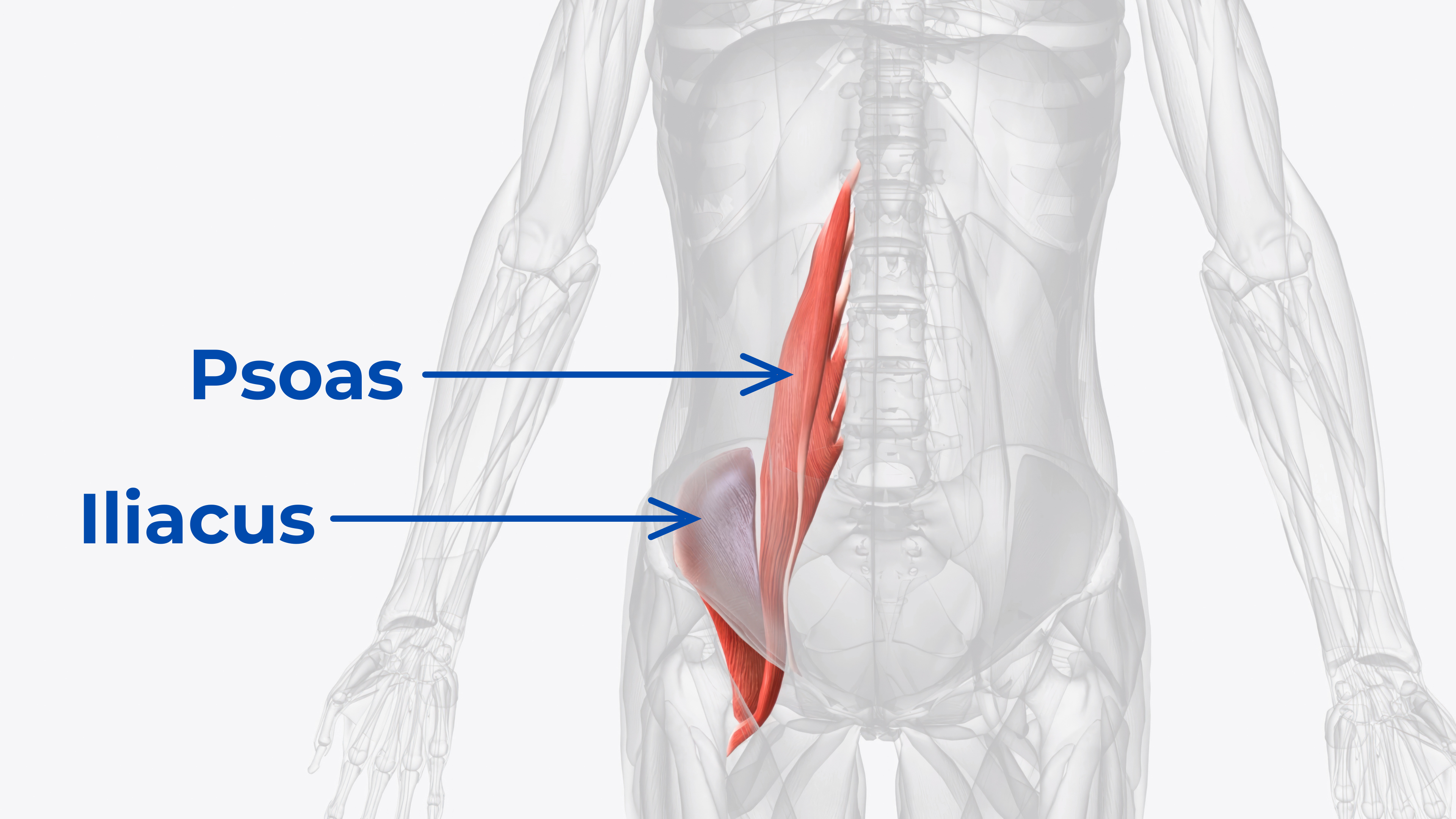
Pre-workout hip flexor release targets both the psoas and iliacus — the two muscles that control hip extension and athletic power output.
In almost every sport, power originates from the hips. A golf swing, a sprint start, a vertical jump, a tackle — all rely on hip extension: the ability to drive the thigh backward explosively from a hip-flexed position.
The muscles that drive hip extension — glutes and hamstrings — work best when their opposites, the hip flexors, can move freely. Those hip flexors are the psoas and iliacus.
When the hip flexors are tight, the muscles that drive hip extension often can't engage as fully — a pattern strength coaches commonly describe as the tight muscle “putting the brakes on” its opposite. The practical result athletes notice: less range, and power that doesn't come through the way it should.
For athletes, those hours of sitting fight against every hour of training.
The Hips Are the Engine
Hip extension is the foundation of explosive movement. When the glutes and hamstrings drive the thigh backward — pushing off the ground in a sprint, rotating through a golf swing, jumping for a rebound — the force generated at the hip is what determines power output.
But that force depends on the hip flexors releasing. If the psoas and iliacus are shortened and tight from hours of sitting, they act like a brake on the glutes. When the psoas and iliacus stay short and tight, the glutes often don't engage as fully. The result athletes feel: less power, shorter range, and hips that feel locked up.
The psoas attaches along the lumbar spine (T12–L5). The iliacus lines the inner surface of the hip bone. Together they form the primary hip flexor complex.
What Tight Hip Flexors Do to Each Sport
Running and Sprinting
- Reduced hip extension means shorter strides and slower top speed
- A tight psoas can pull the lower back into extension, adding strain with every stride
- Persistent psoas tightness frequently shows up as "hip flexor soreness" in the first mile that never fully eases
Golf
- Trunk rotation requires full, symmetrical hip extension and rotation
- A tight iliacus on the lead side restricts the hips from clearing through impact
- Many golfers compensate with excessive shoulder or spine rotation — increasing back stress and reducing power transfer
Basketball and Court Sports
- Explosive first steps require rapid hip flexor contraction AND full hip extension on the push-off leg
- Tight hip flexors reduce the pre-stretch component of explosive movements, diminishing the stretch-shortening cycle benefit
- Hip flexor tightness can leave the muscle working near end-range from a shortened, guarded state, which athletes often feel as tightness or strain
Cycling
- The hip flexors work continuously during cycling, never achieving their full resting length
- Long-term cycling-related hip flexor tightness is one of the most common complaints among cyclists who also run or cross-train
- Post-ride hip flexor release is often more important than post-ride stretching for cyclists who do additional training
Weightlifting and CrossFit
- Tight hip flexors limit squat depth — anterior pelvic tilt compensates for restricted hip flexion
- Under-active glutes reduce deadlift and Olympic lift power output
- Hip flexor tightness can contribute to front-of-knee discomfort during lunges and step-ups
Core Nexus: under 1 lb, compact enough for a gym bag or locker. Two muscle-specific tips on a self-rotating base.
Why Stretching Alone Isn't Enough for Athletes
Athletes stretch. Most serious athletes stretch consistently. And yet hip flexor tightness remains one of the most persistent complaints across sports.
The reason: stretching lengthens the muscle but often doesn't fully release the tight spots within it. Within tight muscle bellies, there are localized zones of contracted, sensitive tissue that can keep tension in place even when the surrounding muscle is stretched.
Those tight spots in the psoas and iliacus are what make hip flexor tightness resilient. An athlete can stretch, feel loose, and then feel tight again within an hour of training because the tight spot was never fully worked out.
Direct, sustained pressure on the tight spots within the psoas and iliacus — before stretching — can carry over better than stretching alone. Sustained pressure helps the tight spot release, and the stretch afterward can then carry over.
The Athletic Pre/Post Protocol
Pre-Workout (Activation)
Release the psoas and iliacus before warming up. This:
- Helps free up the glutes so they engage more readily
- Increases hip extension range of motion before the first movement
- Reduces compensation patterns that develop when the hips are restricted
Focus on each side until the tissue softens and yields. Some days this happens quickly; other days the muscles need more time. The response varies with training load, sleep, and accumulated sitting time.
Post-Workout (Recovery)
Release again after training, when the hip flexors have been working hard and may feel tighter than they did before the session. The muscles are fatigued and may take longer to release — allow slightly more time per side than during the pre-workout session.
Daily Maintenance
Even on rest days, a brief release on each side helps reduce the cumulative shortening that builds over training weeks. Consistency matters more than duration — a short daily session outperforms a long session once a week.
The Tool Requirement
Effective hip flexor release for athletes requires reaching both the psoas (along the lumbar spine, deep in the abdomen) and the iliacus (lining the inside of the hip bone). As described in the NHT anatomy guide, these muscles occupy different spaces and need different tip geometries to reach effectively.
For athletes, there's an additional requirement: stability during dynamic movement. One useful release technique involves slowly rotating the leg outward while under pressure — engaging the hip flexor fibers against the tool for an active release that can feel more complete than static pressure alone. The tool must remain stable during this rotation.
The Core Nexus was designed with athletic use in mind:
- Muscle-specific tips — a wider tip for the psoas and a contoured tip for the iliacus, each shaped for its target muscle
- Self-rotating base — adjusts angle hands-free during leg rotation, maintaining optimal contact throughout the dynamic release
- Stable under body weight — won't roll or shift during movement
- Built from professional-grade TPU — rated for full body weight and built to flex under load instead of cracking
- Compact and portable — under 1 lb (5.5″ × 3.5″ × 3.13″), fits in a gym bag, locker, or carry-on
How Release Methods Compare
| Method | Reaches Psoas? | Reaches Iliacus? | Releases Tight Spots? | Portable for Athletes? |
|---|---|---|---|---|
| Static Stretching | ~ | ~ | ✘︎ | ✔︎ |
| Foam Rolling | ✘︎ | ✘︎ | ✘︎ | ~ (bulky) |
| Lacrosse Ball | ~ (imprecise) | ✘︎ | ~ | ✔︎ |
| Manual Therapy (PT/Massage) | ✔︎ | ✔︎ | ✔︎ | ✘︎ ($$$) |
| Core Nexus | ✔︎ | ✔︎ | ✔︎ | ✔︎ |
The Bottom Line
Tight hip flexors are the silent performance limiter that shows up across every sport. The psoas and iliacus — two muscles most athletes have never specifically worked on — drive hip extension, influence glute engagement, and determine how much power actually reaches the ground.
Stretching alone often doesn't fully release the tight spots that keep these muscles short. And generic tools like foam rollers and lacrosse balls can't reach the depth where the psoas and iliacus live.
A consistent pre/post routine using a tool that reaches both muscles — with the correct pressure geometry for each — is the most practical, portable, and effective option for athletes who train seriously and sit regularly.
Ready to open up your hip extension?
Core Nexus is built for athletic use — compact, stable, and rated for daily training. Lifetime warranty. 30-day money-back guarantee.
Endorsed by Leading Clinicians
Dr. Goñi
MD — Sports Medicine
Dr. Sosa
DC — Chiropractic
Dr. Lang
PT, DPT — Physical Therapy
Dr. McHale
DC — Chiropractic
Dr. Steph Dorworth
PT, DPT — Physical Therapy
Frequently Asked Questions
When the hip flexors — the psoas and iliacus — stay short and tight, the glutes and hamstrings often cannot engage as fully. Since those muscles drive hip extension in sprinting, jumping, and rotational movements, athletes may feel less range and less force coming through than their strength should allow.
Stretching lengthens the muscle, but it often does not fully work out the tight spots within the psoas and iliacus. After stretching, those tight spots can pull the muscle back toward its shortened state. Direct, sustained pressure helps the tight spots release, so the stretch afterward can carry over better.
No. The psoas sits deep in the abdomen along the lumbar spine, behind several layers of muscle and organs. The iliacus lines the inside of the hip bone. A foam roller applies broad, superficial pressure to the front of the hip — it physically cannot penetrate to the depth where these muscles live. It's effective for quads, IT band, and other surface-level muscles, but not for deep hip flexor release.
Ideally before and after every training session. Pre-workout release helps the glutes engage more readily and supports hip extension range of motion. Post-workout release helps work out tight spots in fatigued muscles. Even on rest days, a brief daily session helps reduce the cumulative shortening that builds over training weeks.
Any sport that relies on hip extension — which is nearly all of them. Sprinting and running are directly affected through stride length and speed. Golf swing power depends on hip rotation and extension. Basketball and court sports need explosive first steps. Cycling can create long-term shortening. Weightlifting requires full hip mobility for squats and deadlifts. Athletes who also spend significant time sitting often feel the restriction most.
A lacrosse ball is round and applies point pressure — it can approximate some psoas contact but rolls unpredictably, can't match the contour of the hip bone to reach the iliacus, and provides no stability during dynamic release techniques. Core Nexus has two anatomically shaped tips (one for each muscle), stays stable under body weight, and self-rotates to maintain optimal contact during leg rotation — a technique many people find supports a deeper, more complete release.
Many athletes tell us they feel a difference in hip mobility and glute engagement after their first pre-workout session — the glutes tend to engage more readily once the hip flexors free up. Used consistently as part of a daily routine, most athletes find their range of motion and how they move keeps improving the more they use it.