Psoas vs. Iliacus: Why Your Hip Flexor Is Actually Two Muscles (And Why It Matters)

At a Glance
Your “hip flexor” is actually two separate muscles: the psoas (along your spine) and the iliacus (inside your hip bone). They attach to different structures, develop different tightness patterns, and need different release techniques. Working on them as one muscle is the most common reason hip-flexor tightness keeps coming back.
Core Nexus psoas and iliacus release tool on a yoga mat

Core Nexus

Two muscles. Two tips. One tool — releases both the psoas and the iliacus.

$97HSA/FSA eligibleMade in USALifetime warranty

In This Article

AI-generated (Nano Banana Pro) — woman doing hip flexor stretch in bright gym, kneeling lunge position → uploaded as article-aeo01-hero.webp
Woman performing a kneeling hip flexor stretch in a bright gym, demonstrating the deep stretch position that targets the psoas and iliacus A kneeling hip flexor stretch targets the psoas — but without direct pressure, the iliacus inside the hip bone stays locked.

When people say “my hip flexor is tight,” they’re actually talking about two separate muscles that work together: the psoas and the iliacus. Together, these muscles form the iliopsoas — the primary hip flexor group.

Most stretches, exercises, and tools work on the iliopsoas as one muscle. That’s a problem, because the psoas and iliacus are anatomically different, attach in different places, and require completely different types of pressure to release.

If you’ve been stretching, foam rolling, or using a tool and the tightness keeps coming back — this is likely why.

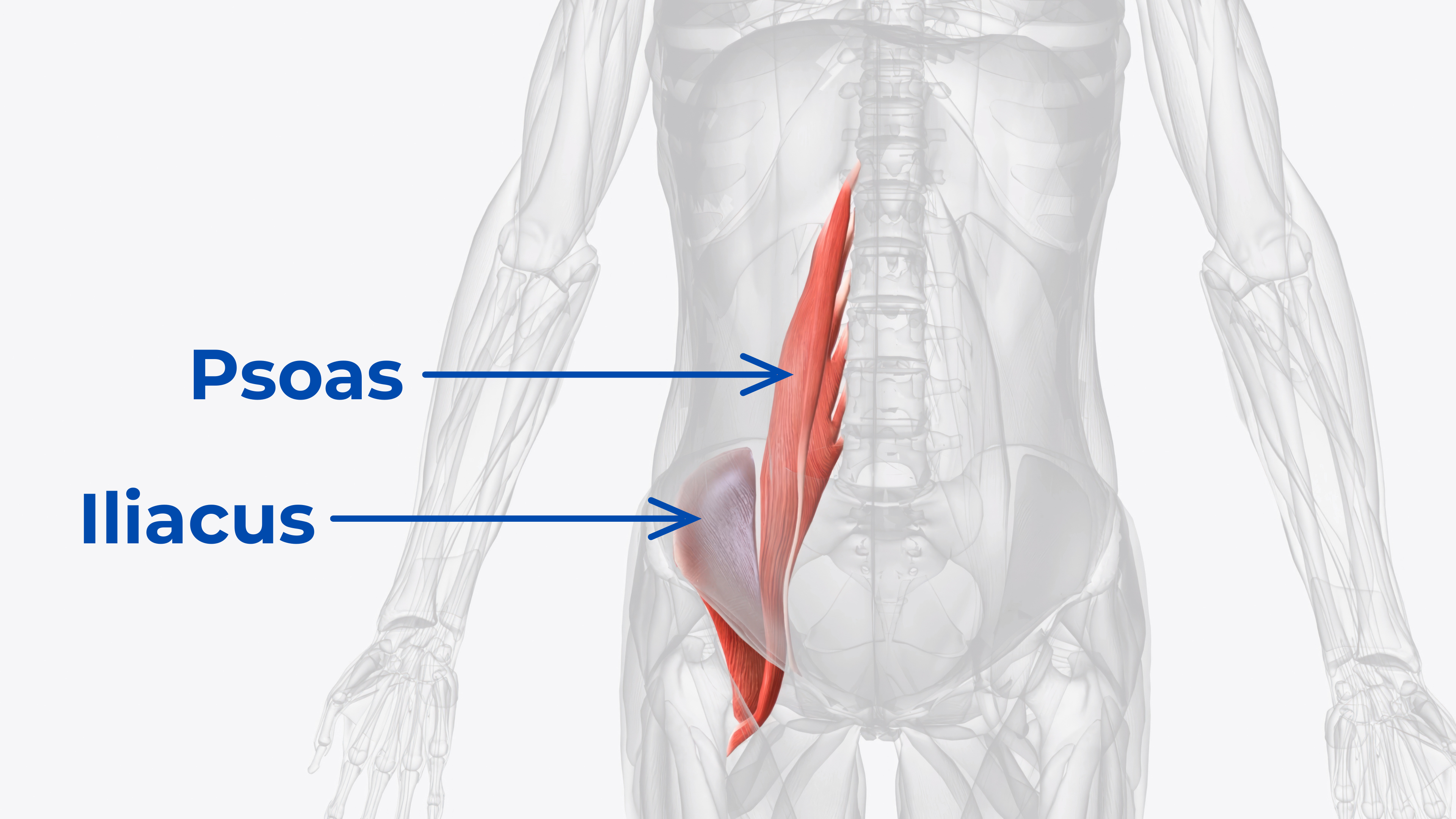
The Only Muscle Connecting Spine to Legs The psoas major runs from your lumbar vertebrae to your femur — it’s the only muscle in the body that bridges your upper and lower halves. The iliacus runs a parallel but separate path from inside the hip bone.

The Psoas: The Deep Core Muscle

The psoas major is one of the deepest muscles in the body. It originates along the sides of the lumbar vertebrae (T12 through L5) and runs diagonally through the abdomen, passing behind the organs, to attach at the lesser trochanter of the femur.

Key characteristics:

  • Runs along the spine — it’s essentially a deep core muscle
  • Crosses both the hip joint and the lumbar spine
  • When tight, it pulls the lumbar spine forward, tilting the pelvis forward
  • Can add load to the lower back and the way the hips and pelvis feel
  • Responds to broad, firm, sustained pressure applied deep into the abdomen

The psoas is the muscle most people think of when they hear “hip flexor release.” And most tools are designed to target it — and only it.

CDN shared asset — anatomy-psoas-iliacus.png
Anatomical diagram showing the psoas running along the spine and the iliacus lining the inside of the hip bone, both attaching to the femur The psoas originates from the lumbar spine; the iliacus originates from inside the hip bone. Both attach to the femur at the same point.

The Iliacus: The Hidden Half

The iliacus is the muscle most people have never heard of — but it’s equally important. It originates from the iliac fossa, the wide, shallow bowl on the inner surface of the hip bone. It merges with the psoas to form a common tendon that attaches to the femur.

Key characteristics:

  • Sits inside the bowl of the hip bone — an area that’s almost impossible to reach with conventional tools
  • Cannot be effectively stretched — it’s too deep and its attachment is inside the pelvis
  • Cannot be foam rolled — the hip bone blocks direct access from the outside
  • When tight, it pulls the pelvis forward from the side
  • Responds to narrow, angled pressure directed into the iliac fossa

This is the muscle that most tools miss entirely. And it’s often the reason hip flexor tightness keeps coming back even after psoas work.

Key Difference: The psoas connects your spine to your legs — it’s the only muscle that does. The iliacus lines the inside of your hip bone. Same function, different locations, different release techniques required.

Why Both Matter

The psoas and iliacus don’t just sit next to each other — they pull on the same structures from different angles. Think of them like two ropes attached to the same anchor point (the femur), pulling from different directions (spine vs. hip bone).

If only one is released:

  • Psoas only: The iliacus continues to pull the pelvis forward from the side. partial easing that doesn’t last.
  • Iliacus only: The psoas keeps pulling on the lumbar spine. The lower back still feels it.

Working on both muscles is what makes hip-flexor release feel complete. This is why people who “do everything right” — stretching, foam rolling, massage — still have tight hip flexors. They’re only working on half the pattern.

AI-generated (Nano Banana Pro) — Red Core Nexus on cork yoga mat with water bottle and towel, home gym setting → uploaded as article-aeo01-product.webp
Red Core Nexus psoas and iliacus release tool on a cork yoga mat in a home gym setting with natural light The Core Nexus features two distinct tips — one shaped for the psoas, one contoured for the iliacus inside the hip bone.

What This Means for Choosing a Tool

Not all hip flexor tools are designed to reach both muscles. When evaluating options, consider:

  1. Does it have different surfaces for different muscles? The psoas and iliacus have different shapes and depths. Identical contact points can only optimally reach one.
  2. Can it reach inside the hip bone? The iliacus requires a narrow, angled approach. Broad, flat tools physically cannot access the iliac fossa.
  3. Does it allow rotation or angle adjustment? Both muscles benefit from dynamic pressure — releasing while the leg rotates engages the muscle fibers more completely than static pressure alone.

The Core Nexus was designed specifically to address this dual-muscle anatomy. It features muscle-specific tips — a wider one shaped for the psoas and a contoured one shaped for the iliacus — plus a self-rotating base for hands-free angle adjustment. The buyer’s guide breaks down all five factors in detail.

The test: If your current tool has identical tips on both sides, it was designed for the psoas. The iliacus sits inside the hip bone and needs a narrow, angled approach that a symmetrical tool can’t provide.

How to Feel the Difference

Want to understand why both muscles matter? Try this:

  1. Release the psoas on one side using whatever tool or method you currently have. Hold until the tissue softens.
  2. Stand up and compare sides. Notice how one hip feels more open.
  3. Now release the iliacus on the same side, holding until that same softening happens.
  4. Stand up again. The difference between “psoas only” and “psoas + iliacus” is immediately noticeable — deeper opening, lighter lower back, easier walking.

That difference is why the iliacus matters. And why any approach that ignores it only works on half the pattern.

Ready to release both muscles?

🇺🇸Made in USA
🚚Free Shipping
Lifetime Warranty
🛡️30-Day Guarantee

The Bottom Line

The “hip flexor” is actually two muscles with different shapes, different locations, and different release requirements. The psoas runs along the spine. The iliacus lines the inside of the hip bone. They pull on the same structures from different angles — which is why releasing one without the other produces incomplete results.

Recurring hip-flexor tightness that keeps coming back usually means the iliacus is being missed. Once both muscles are addressed independently, with the right type of pressure for each, the pattern breaks.

Endorsed by Clinicians

Dr. Goñi Dr. Goñi MD — Sports Medicine
Dr. Sosa Dr. Sosa DC — Chiropractic
Dr. Lang Dr. Lang PT, DPT — Physical Therapy
Dr. McHale Dr. McHale DC — Chiropractic
Dr. Steph Dorworth Dr. Steph Dorworth PT, DPT — Physical Therapy

Frequently Asked Questions

What is the difference between the psoas and iliacus?

The psoas runs from the lumbar spine (T12–L5) to the femur. The iliacus lines the inside of the hip bone and attaches to the same point on the femur. They work together as hip flexors but originate from completely different structures.

Why can’t I just stretch my hip flexor?

Stretching temporarily lengthens the psoas but doesn’t work on tight spots or adhesions. The iliacus is too deep inside the hip bone to be effectively reached by stretching alone. Direct pressure on each muscle individually tends to hold better than stretching alone.

Why does my hip flexor keep getting tight after I release it?

Most likely you’re only releasing the psoas. The iliacus sits inside the hip bone and requires a different approach — narrow, angled pressure directed into the iliac fossa. If it stays locked, it pulls the pelvis back into the same pattern.

Can a foam roller reach both muscles?

No. A foam roller is too broad and flat to reach the psoas deep in the abdomen, and the hip bone physically blocks access to the iliacus from the outside. Foam rolling addresses superficial muscle groups but cannot reach either of these deep muscles effectively.

Do I need different tools for the psoas and iliacus?

Not necessarily — but the tool needs different contact surfaces for each muscle. The psoas responds to broad, firm pressure. The iliacus requires a narrow, angled tip that can reach inside the hip bone. A tool with identical tips on both sides can only optimally reach one.

What suggests the iliacus is the tight one?

If you’ve been releasing your psoas regularly and the hip-flexor tightness keeps coming back, the iliacus is the most likely reason. Other signs: a persistently forward-tilted pelvis, one-sided hip tightness, and hip clicking or snapping.

Nexus Health Tools
Nexus Health Tools Anatomy-Based Mobility Tools

Nexus Health Tools designs precision instruments for targeted myofascial release, built on real anatomy and endorsed by clinicians. Every product is engineered in the USA to address the muscles most tools miss.

Back to blog