The Suboccipital Connection: Why Neck Tension May Start at the Base of Your Skull
📖 In This Article
- The Muscles Nobody Talks About
- Why They’re Different From Other Muscles
- How the Suboccipitals Tighten
- Where the Tension Goes
- Why Standard Approaches Only Partially Help
- Direct Suboccipital Release
- The Desk Worker Stack
- Neck Tool Comparison
- The Bottom Line
- Frequently Asked Questions
- Endorsed by Clinicians
The Black Swan in use — gravity-assisted suboccipital release at the base of the skull.
Most conversations about head and neck tension focus on triggers — stress, dehydration, screen time, sleep. These are all real factors. But there is a common source of tension at the base of the skull that rarely gets discussed: the suboccipital muscles.
These four small muscles sit at the base of the skull, buried beneath the larger trapezius and splenius muscles. They are responsible for fine head movements — the small adjustments in nodding, tilting, and rotation that keep the head balanced in space. And in a world where most people hold their heads forward for hours each day, these muscles are under constant, unrelenting load.
Understanding why the suboccipitals matter — and how to release them directly — is what separates chasing the symptom from working on the tension pattern itself.
The Muscles Nobody Talks About
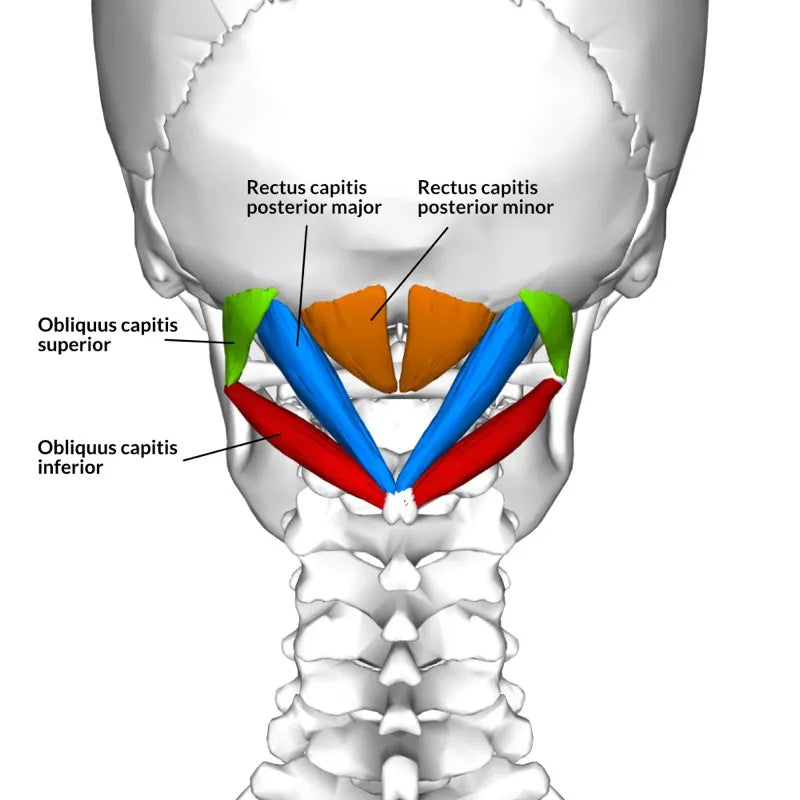
The suboccipitals are a group of four muscles connecting the first and second cervical vertebrae (C1 and C2) to the occipital bone at the base of the skull:
| Muscle | Connection |
|---|---|
| Rectus capitis posterior major | C2 (axis) → occipital bone |
| Rectus capitis posterior minor | C1 (atlas) → occipital bone |
| Obliquus capitis superior | C1 (atlas) → occipital bone |
| Obliquus capitis inferior | C1 ↔ C2 (connects the two vertebrae) |
Together, these four muscles handle the fine motor control of the head — the precise adjustments that keep gaze steady, balance the skull on the spine, and allow smooth rotation. They are small but powerful, and they are working every second the head is held upright.
The four suboccipital muscles at the base of the skull. These deep muscles sit beneath the trapezius and splenius, making them difficult to reach with surface-level work.
Why They’re Different From Other Muscles
The suboccipitals have an extraordinary concentration of proprioceptors — sensory receptors that tell the brain where the head is positioned in space. Per gram of tissue, the suboccipital muscles contain more proprioceptors than almost any other muscle in the body.
This makes them neurologically sensitive in a way that other muscles are not. When the suboccipitals become tight, the constant sensory feedback they send to the brain can be felt far more intensely than the mechanical tension alone would suggest. This is why tightness here can feel disproportionate to the amount of tension actually present.
How the Suboccipitals Tighten
The primary driver is forward head posture — the position the head drifts into when looking at screens, driving, or reading. For every inch the head moves forward from neutral, the effective weight the neck muscles must support increases by roughly 10 pounds. At two inches forward — a common desk position — the suboccipitals are supporting an extra 20 pounds of effective load.
Over hours of screen time, these muscles fatigue and contract. The surrounding connective tissue thickens with repeated tension cycles, and what started as temporary tightness settles into a lasting tension pattern.
Other Contributors
- Stress and clenching — Jaw clenching and shoulder guarding transmit tension directly up into the suboccipitals through the fascial chain.
- Poor sleep position — Stomach sleeping with the head twisted stresses the upper cervical muscles for hours at a time.
- Old injuries and strain — The suboccipitals are frequently involved after neck strain and often remain guarded long after the initial soreness settles.
- Progressive lenses and bifocals — Constantly tilting the head to use the correct portion of the lens stresses the upper cervical alignment throughout the day.
Where the Tension Goes
When the suboccipitals are tight, the tension is often felt in characteristic patterns:
- Deep ache or tightness at the base of the skull — right where the muscles attach to the occipital bone.
- Tension that wraps over the top of the head — following the pathway of the greater occipital nerve as it courses upward from the suboccipital region.
- Tension felt behind the eyes — a common referral pattern when the suboccipitals are tight around the greater and lesser occipital nerves.
- Neck stiffness and reduced rotation — particularly difficulty turning the head fully to one side.
This is the tension pattern most people notice as a build-up of pressure at the base of the skull. It typically intensifies through the workday and is often accompanied by neck tightness and eye strain. The pattern itself is the clue: tension that builds through the day and centers at the base of the skull very often traces back to the suboccipitals.
Why Standard Approaches Only Partially Help
Most approaches to this kind of tension work on the surface without reaching the deeper muscles. Here is where the most common approaches fall short:
General OTC approaches: Can dull the sensation for a while but don’t change the underlying tightness. The muscles stay tight, and the tension tends to return.
General neck stretching: Stretches the larger superficial muscles — the trapezius and splenius — without reaching the deep suboccipitals beneath them. Temporarily helpful but incomplete.
Massage therapy: A skilled massage therapist can reach the suboccipitals. But the muscles are deep, the session is expensive, and any easing is temporary if the daily posture drivers aren’t addressed between visits.
Heat: Eases muscle guarding temporarily. No deeper change to the underlying tension pattern.
The most effective approach is direct, sustained pressure applied to the suboccipital muscles themselves — combined with addressing the postural habits that build the tension in the first place.
Direct Suboccipital Release
The suboccipital muscles attach to the base of the skull (occipital bone) and the upper cervical vertebrae. They are accessible from behind when lying supine — the weight of the head provides the pressure, and gravity does the work.
Technique
- Lie on a firm surface (floor, yoga mat, or bench).
- Place a suboccipital release tool at the base of the skull, beneath the bony ridge of the occiput.
- Relax the full weight of the head into the tool — gravity applies the pressure.
- Hold for several minutes, breathing slowly. Let the tissue soften on its own schedule. Do not force the release.
- Optional: gentle head nodding or slow rotation to engage different fibers of the suboccipital group.
The key is conforming contact. The tool needs to sit against the curved base of the skull without sliding, shifting, or creating uncomfortable point pressure. A cradle-style design that accommodates the skull’s natural curve is more effective than a ball or flat surface, because it maintains stable, distributed contact across the attachment sites.
The Black Swan’s dual occipital cradles and cervical channel — engineered to conform to the skull base for stable, gravity-assisted pressure.
The Black Swan by Nexus Health Tools was designed specifically for this application. Its dual occipital cradles in two widths conform to the skull base, provide stable gravity-assisted pressure, and allow gentle head movement without the tool shifting. Built-in ramps provide simultaneous gentle cervical traction — three functions (suboccipital release, neck stretch, and hand/forearm recovery) in a single tool.
The Desk Worker Stack
For desk workers who feel both base-of-skull tension (suboccipitals) and lower-back tightness (hip flexors), addressing both patterns in a single daily routine tends to work best. These are the two most common tension patterns for people who sit for extended periods, and they compound each other:
- Forward head posture tightens the suboccipitals → tension at the base of the skull, neck stiffness, pressure behind the eyes.
- Anterior pelvic tilt tightens the psoas and iliacus → lower-back tightness, hip stiffness, front-of-hip tension.
Both patterns develop simultaneously during prolonged sitting, and each reinforces the other throughout the workday. Addressing both — rather than chasing one sensation at a time — works on the compounding postural pattern.
- Suboccipitals: Black Swan — daily suboccipital release and neck tension release.
- Hip flexors: Core Nexus — daily psoas and iliacus release.
Neck Tool Comparison
| Feature | Black Swan | Neck Hammock | Massage Balls |
|---|---|---|---|
| Suboccipital Release | ✔︎ | ✘︎ | ~ |
| Conforms to Skull Curve | ✔︎ | ✘︎ | ✘︎ |
| Cervical Traction | ✔︎ | ✔︎ | ✘︎ |
| Forearm / Carpal Tunnel | ✔︎ | ✘︎ | ✘︎ |
| Gravity-Assisted | ✔︎ | ✔︎ | ✘︎ |
| Stable Contact (No Rolling) | ✔︎ | ✔︎ | ✘︎ |
| Multi-Width Cradles | ✔︎ | ✘︎ | ✘︎ |
| Professional-Grade Material (TPU) | ✔︎ | ✘︎ | ✘︎ |
| Made in USA | ✔︎ | ✘︎ | ~ (varies) |
The Bottom Line
Tension that starts at the base of the skull, builds through the workday, and wraps over the head or is felt behind the eyes very often traces back to the suboccipitals. These muscles are neurologically dense, heavily loaded by forward head posture, and buried too deep for surface-level approaches to reach effectively.
Direct, gravity-assisted pressure — applied to the specific attachment sites at the skull base — is the most effective self-care approach for this pattern. A tool designed to conform to the skull’s curve, maintain stable contact, and allow gentle movement during the release is the difference between quick, fading easing and a steadier shift in the tension pattern.
The Black Swan was built for exactly this. Dual occipital cradles, built-in cervical traction ramps, and a hand/forearm recovery surface — three tools in one, engineered for the muscles most tools miss.
Ready to release neck and suboccipital tension?
Endorsed by Clinicians
Dr. Goñi
MD — Sports Medicine
Dr. Sosa
DC — Chiropractic
Dr. Lang
PT, DPT — Physical Therapy
Dr. McHale
DC — Chiropractic
Dr. Steph Dorworth
PT, DPT — Physical Therapy
Frequently Asked Questions
The suboccipitals are four small muscles at the base of the skull that control fine head movements. They contain an extraordinarily high concentration of proprioceptors (nerve endings that sense position), which makes them neurologically sensitive. When tight, the constant sensory feedback they send to the brain can be felt far more intensely than the actual muscle tension would suggest — which is why tension here can feel disproportionate to the amount of tightness present.
Suboccipital tension tends to follow a characteristic pattern: a deep ache at the base of the skull, tightness that wraps over the top of the head, pressure felt behind the eyes, and neck stiffness with reduced rotation. It typically builds through the workday and intensifies with prolonged screen time. If this matches the pattern, the suboccipitals are a sensible first place to look.
Standard neck stretches primarily target the larger superficial muscles — the trapezius and splenius — without reaching the deep suboccipitals beneath them. The suboccipitals respond to direct, sustained pressure at their attachment sites on the skull base. Stretching the muscles above them provides temporary easing but does not reach the deeper tension.
For desk workers who deal with regular neck and base-of-skull tension, daily suboccipital release tends to work best. Start with two to three minutes per session and gradually increase to five to ten minutes. Consistency matters more than duration — a brief daily release tends to work better than a longer session once a week.
Balls can apply pressure to the general area, but they roll, shift, and create inconsistent point pressure rather than conforming to the skull’s natural curve. The suboccipitals are positioned in a specific concavity at the skull base, and a tool designed to cradle that curve — like the Black Swan’s dual occipital cradles — maintains stable, distributed contact across the correct attachment sites without sliding.
The desk worker stack addresses the two most common tension patterns from prolonged sitting: suboccipital tightness (felt at the base of the skull and neck) and hip flexor tightness (felt across the lower back and front of the hips). The Black Swan targets the top of the chain at the skull base, while the Core Nexus targets the bottom at the psoas and iliacus. Addressing both in a single daily routine works on the compounding postural pattern rather than chasing individual sensations.
The Black Swan is three tools in one. Its primary function is suboccipital release and neck tension release, but it also provides cervical traction through built-in ramps and doubles as a forearm and carpal tunnel release tool. For desk workers, this covers the three most common upper-body tension patterns in a single device.
Shop NHT Direct